
Face Huggers from ALIEN

In ALIEN, the first live creature from another planet we are introduced to is the Face Hugger. (Shortly after seeing some other giant dead guy who had been an unfortunate victim.)
The Face Hugger is found by John Hurt when he explores a crashed space craft and discovers that it is full of strange leathery egg things (which turn out to be eggs). When he notices movement inside one of the eggs, rather than backing away like a sensible person in a horror film, he puts his head right up close allowing the Face Hugger an unmissable opportunity to hug face.
The Face Huggers job is to impregnate a host who will later be killed by a miniature Gieger Alien that bursts from its chest. Once the host is impregnated, the Face Hugger dies.
The first problem with this, is that the Face Hugger requires an alien species (alien to itself) to latch onto and force into becoming a host. Most species have a suitable male/female set up allowing for the race to reproduce alone. It’s certainly possible that on the Gieger Alien homeplanet that there are other species that it relies on to impregnate, or even possible that Face Huggers attack Aliens from other tribes or clans or however their society works. This however does not explain the other problem:
They are a completely redundant phase of reproduction.
Why have a seperate creature to impregnate alien hosts with the seeds to grow into full Aliens, when there is already an alien/egg relationship. The Face Hugger is literally a reproduction middle man. Cut it out and you have Aliens laying eggs, which hatch into little Aliens. Like any normal bird or lizard or other egg laying creature.
Oh but hang on! Through the miracle of research, it turns out that some species on Earth actually follow this pattern of egg>middle man>offspring>egg.
Some types of parasitic flatworms called Digenea actually have up to three seperate creatures involved in reproduction. The adult will lay an egg, which hatches into a larva (known as the mother sporocyst). This parasitic larva, in a similar way to the face hugger will find a host to latch on to. Usually this will be a mollusc. The mother sporocyst will then be able to give birth asexually to daughter sporocysts. The daughters will find other molluscs to attach to and continue reproducing. The daughters however give birth to the baby versions of the original flatworm, which when reaching maturity lays more eggs.
This cycle allows the potential to reproduce hundreds of offspring from one egg. The parasites continue to reproduce throughout their natural life. One mother will keep producing daughters, who in turn will keep producing babies to each produce more eggs.
The face hugger then is a terrible middle man. It is only able to plant one seed before it rolls over and dies. Talk about a lack of efficiency. One Face Hugger equals one Alien. There’s no option for it to latch on to one host and then wander off to find another increasing the Alien population infinitely until it is killed by anything other than redundancy.
Twi’lek Males from Star Wars

In any sexy dance club or greasy Hutt gangster lair, you will find at least one beautiful shapely Twi’lek girl moving her hips and swaying to the music.
They are the most popular fantasy figures (in the sexual sense, not the LOTR sense) in the Star Wars galaxy, capable of inspiring lust in probably any other species. A notable exception is the Rancor, who licks his lips for another reason.
But then, you turn to the males of the species. They look like the elephant man with an amputee octopus on his head. Their teeth are spiny, and they have long crooked fingers with claw like nails. They are absolute beasts in comparison.
Now you could argue along the lines that Pug dogs (or Remoolians) are able to find each other attractive enough to breed and that beauty is relative. But in this case it just seems insane that the female should be so universally attractive, while the male is galactically repugnant. When the men on their homeworlds are so sith-spitting ugly, it’s no surprise that we commonly find the women desperately flaunting themselves in seedy cantinas and gangster dens trying to gain the attention of any other species!
Although, the obvious dissimilarities are there between the genders, it seems as though Twi’lek women must have over the years become able to find their counterparts attractive. (Maybe they have a good sense of humour). This could be ample reason for Jedi Rear of the Year Aayla Secura becoming enamoured with fish-face Fisto. (Not a Twi’lek)
Although, if the females have evolved to find ugly creatures attractive, they would still fare much better on other planets. They’d have their pick of the Sullustans, Rodians and Duros guys out there, who I’m sure would be ready and willing at a moments notice to get their mitts on a Twi’lek woman.
Martians from War of the Worlds
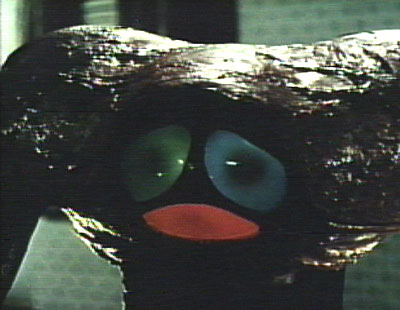
These guys had it all. They were physically, mentally and technologically superior to humanity. They came in their huge warships and walked around with in their tripods (which were alone enough to make most men feel inadequate) destroying anything that they took a disliking to and conquering everything else.
The Human race did not stand a chance. No matter what they threw at them, the Martians were capable of withstanding it.
Right up until one of them caught a sniffle. Then as is the way with colds, it got passed around everyone in the tripod office until they all had it. Then they died. They died because their bodies immune systems were not able to cope with this Earth based virus.
Maybe this is a bias, because as a human myself I have fought off many colds, some of which barely got past the irregular sniffing stage and find it to be an unworthy opponent. But still, you’d think any biological creature, whether or not from another world, would still have it’s own diseases to face and some kind of in built defence mechanism which could stretch to battling other world infections in the same way.
Even if they did have trouble fighting off a foreign virus, (as many explorers of strange places do) they had the run of the planet. No one was going to stop them running into a pharmacy and picking up some cough drops.
Or in the case that they couldn’t speak the language and were unable to read the label, where was their own technology then? Maybe that’s what you get for putting all your money into war machines and not enough into medicine.
It’s an odd thing, that they were:
A – physically superior to us, yet lacking in the immune system department.
B – mentally superior to us, yet lacking the foresight to prepare for biological warfare.
C – technologically superior to us, yet lacking in the medical care to fight off the common cold.
Abzorbalovian from Doctor Who
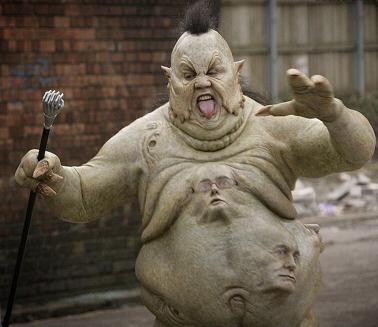
As the name of the creature suggests, this is an alien that devours its prey by absorbing their bodies along with their memories and consciousness. All it requires to do so is one touch.
So far, despite the name (which can be forgiven as it came from a nine year old) this seems like an efficient way of feeding.
No need for cutlery or any washing up afterwards.
Though the first problem with this creature is that it required a device called a limitation field in order to stop it from devouring everything that it came into contact with, like some sort of gluttonous Midas touch. The one seen in the episode carried a cane which kept his absorption ability under control.
This is a minor difficulty, overcome by a small amount of futuristic technology compared to the other more fatal flaw of the creature.
Once devoured, its prey remain alive and conscious inside the alien. Often, their faces will push against its stomach creating an outline like the ones that you get if you put yours into one of those needle toy things.
(One of these)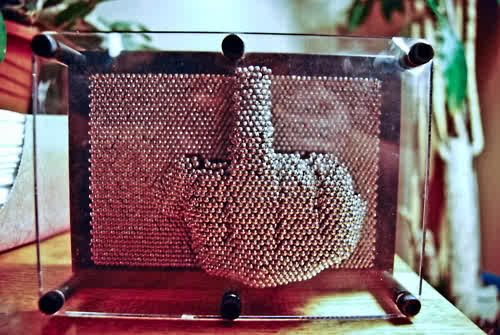
The prey, while inside the Abzorbaloff, shares its consciousness and memories with the alien. It does not die for at least a few days. So privacy for this creature is nigh on impossible whenever it has a meal. This also suggests that the Abzorbaloff gains no nutrition from its prey for what could be a week after consumption.
That is still not the worst of it.
All that is needed for the prey to escape, thus killing the Abzorbalovian host, is to wish hard enough to get out. The shared mental activity allow this to happen, and its likely that prey might even stumble across this knowledge in the aliens mind.
As far as escaping death goes, this is pretty straight forward. The majority of creatures are opposed to being eaten alive and the desire for it to not happen, particularly when it is actually happening, should be very powerful. So this creature pretty much faces its own death every time it has a meal.
In the Doctor Who episode, it seemed as though it was the combined wishes of a number of meals to escape that defeated the Abzorbaloff, so maybe it is able to withstand the desire of one or two meals. But if all of these creatures are eating as often as this one did, then their entire race will be on the endangered species list in no time.
Rigellian Chelon from Star Trek
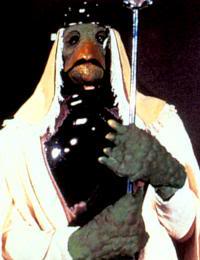
The Rigellian sector of the galaxy is a heavily populated area according to sci fi, being home to a number of species from a number of shows including the green tentacled guys from the Simpsons.
Among them stand the Chelon race from Rigel III. These people evolved from a race of saber-toothed turtles, no different to the variety on our own planet besides the teeth.
Now as humanoids, they have lost their protective shells and their fangs have become less pronounced. However, they still prefer living as amphibians and retained the lack of agility common among turtle-kind.
It is as though their evolution seemed to give up half way through. They were changing from a wild animal into an intelligent sentient being, losing the elements that protected them in the wild, yet their bodies still required that they stay in their natural habitat, probably alongside creatures that considered them prey.
As we all know, humans are the most powerful predator on our planet, so it’s probable that in the same way the Chelons used technology and intelligence to survive against their wild predators, but surely their evolution should have seen them able to live away from swampland in the safety of cities like every other humanoid in the galaxy.
Or at least would have still allowed them some of the protection of their old bodies. A fair guess, based on their having fangs would suggest that the Chelons were carnivorous. That is unlikely to have changed, yet their mouths seem to more resemble the vegetarian turtles of Earth, making the chewing of meat quite difficult.
Their other loss, the shell, was not replaced by greater agility to counter the lack of strength. This leaves the Chelon as a slow, weak and vulnerable creature.
So for survival we’re left with intelligence. The Chelon were able to construct space craft for galactic exploration and the like, so we can judge that they were smart enough to deal with technology.
Their logic can be questioned though with their hierarchy system. Usually a Lord would travel with an attendant. They would behave as their names suggest, with the attendant serving, protecting and feeding the Lord, yet the Lord would actually be of lower rank. The Lords’ function was simply to carry and lay eggs while the attendant was the true commander.
We can agree that it is important to take care of pregnant women sure, but wouldn’t it make more sense for an attendant to be an attendant who serves full time, while a Lord spends their time doing Lordy things like ruling and being political? Or at least call the pregnant turtle something that doesn’t imply power.
Maybe I’m just being racist against turtles from other planets, but I think we’re better off with our own Ninja Mutant Turtles. They come with half-shells, swords, staffs, sai, nunchaku, a blimp, sewer speeder and as much pizza as you can manage. Everything that the Chelons are missing.
Ballchinian from Men in Black II
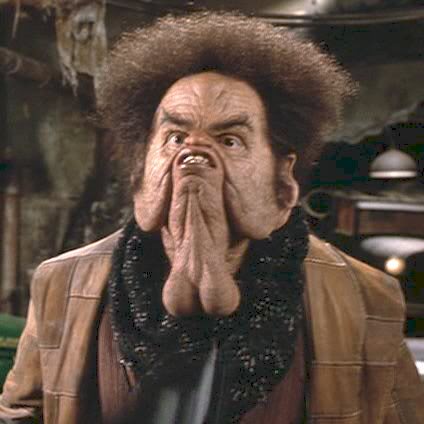
For all intents and purposes, this is a human with his most sensitive area dangling from his chin, there for all to see and to take advantage of in a fight. The line ‘Nothing below the belt’ holds no relief for this species.
Now I could leave this here and simply say that the dangerous position of the scrotal sack is enough for this guy to sit comfortably on this list. However, there is one other point about him that proves him a failed design.
Human male genitals are part nutbag and part salami shaft. They all dangle in a collection between the legs. The Ballchinians rocks, as we know, hang from his face. We can only assume that the rod is in the same place as it would be if he were human. We at least know it isn’t just above the plums, it could be anywhere else.
In humans, the gonads and gluestick form a close knit system allowing for efficient expulsion of reproductive matter. This guys little guys have to swim half way across his own body before they find their exit.
Maybe this makes him last longer in bed, something that many Earth women would be happy for, but it likely also decreases the amount of swimmers who make it across the Channel.
At this point in the article, the innuendo has gotten the better of me, but I think I have made my point.
Mattress from Hitchikers Guide to the Galaxy
This creature is simply a living version of the type of mattress found in most bedrooms. Their only purpose is to be killed and used in the same way as their manufactured counterparts thereby saving the process of actually making mattresses to be slept on.


